
Dhyan Chand Biography, Life, Olympics, Records, Net Worth
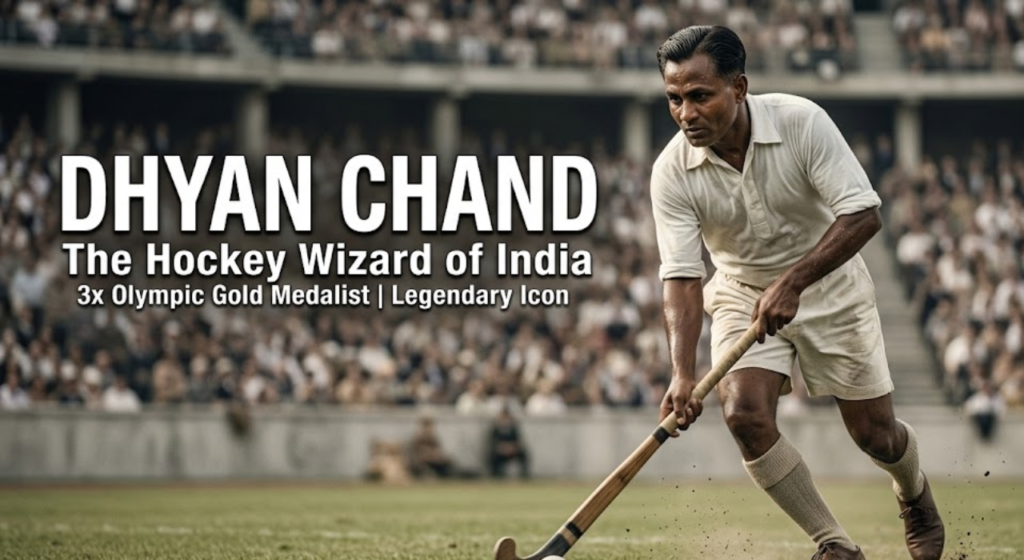
Dhyan Chand
Athletes then there are legends that change the meaning of sport. Major Dharma Chand is definitely in the second. It is not just a story of India hockey with goals in Dhyan Chand biography. A story about a boy making his way up the ladder, who turned himself into probably the greatest player of field hockey ever, renowned and feared. With a stick in his hands, he foreshadowed as wizardry. He donned an army uniform before a jersey but he never carried anything on the pitch other than his country’s pride. Even today his name is invoked before you discuss hockey, Indian sports or Olympic excellence.
Personal Details
| Detail | Information |
| Full Name | Dhyan Singh (known as Dhyan Chand) |
| Date of Birth | August 29, 1905 |
| Place of Birth | Allahabad, Uttar Pradesh, India |
| Date of Death | December 3, 1979 |
| Nationality | Indian |
| Religion | Hindu (Bais Rajput) |
| Sport | Field Hockey |
| Position | Centre-Forward |
| Army Rank | Lance Naik (retired as Lieutenant) |
| Nickname | The Wizard, The Magician of Hockey |
Early Life and Family Background
Birth and FamilyThe Dhyan Chand biography begins in Allahabad, which was built on 29 August 1905 in a Bais Rajput family. Sameshwar Dutt Singh Bais, his father was a soldier in the British Indian Army and an avid hockey player himself. His mothers name is Sharadha Singh. He had two brothers Mool Singh and Roop Singh. In time, Roop Singh would himself become an iconic hockey player and would even join Dhyan to play the 1932 Olympic Games.
Dhyan’s childhood saw the family moving across various locations with his father posted to army camps. This incessant moving led him to halt traditional schooling after only six years. The family later settled in Jhansi, Uttar Pradesh, where Dhyan grew up. He studied at Aligarh Muslim University and graduated from Victoria College, Gwalior in 1932.
Little known fact, Dhyan was not attracted to Hockey initially. Wrestling was his first sporting love. Hockey came into his life only after he joined the army and changed that life completely. With tree branches as hockey sticks and balls made of used rags, a minor point nearly tells us how relentless and innovative he is.
Army Life and Entry into Hockey
Dhyan Chand, born on August 29, 1905, joined the British Indian Army in 1922 at the age of only 17 as a Sepoy (private sodier) after completing his schooling and enrolled himself in the 1st Brahmans regiment. This was when his love for the game of hockey was born! Between the years 1922-1926 he participated in regimental tournaments as well as army hockey competitions. He came on strong and fast.
Of all the sweet details tucked inside, one of the most endearing anecdotes in the Dhyan Chand biography comes from where he got his nickname. His fellow soldiers named him “Chand”, which means moon in Hindi, because he used to practice under the moon after finishing his military duties. His commitment to the game after hours demonstrated itself as he took to the moonlit field as a training ground.
In 1926, his playing ability saw him selected in the Indian Army side on a tour to New Zealand. India did very well with 18 victories against only two draws. This was also the time when Dhyan Chand emerged as a superstar, captivating imaginations with his dribbling and goal-scoring prowess. On his return to India, he was later promoted to Lance Naik in the Punjabi regiment.
The 1928 Amsterdam Olympics
The turning point in Dhyan Chand biography comes in the year 1928. Apart from field hockey being back to the Olympic Games after an extended break, a new Indian Hockey Federation (IHF) was keen on sending its best team. A tournament was organized between the provinces, played among five teams headed by Punjab, Bengal, Rajputana, United Provinces and Central Provinces. Dhyan Chand was allowed by the army to play for United Provinces and went on to be phenomenal, earning a spot in India’s very first Olympic hockey team.
In Amsterdam, India was unstoppable. Playing as a centre-forward, with 14 goals in five matches, he was by far the top scorer of the tournament – nine more than the next best. India won its first Olympic gold medal over a week ago, beating the Netherlands 3-0 while many leading players were sick. His win was so sensational that it is even reported Dutch officials broke Dhyan’s stick to examine hidden magnets. An aged Dutch woman approached him to play with her walking cane, which he proceeded to use to aggregate scores in a story that encapsulated the wonders around him.
The 1932 Los Angeles Olympics
At the 1932 Los Angeles Games, there was no trial for Dhyan Chand. He was a no-brainer, while teammates fought for their spots. Making it a historic family affair: his brother Roop Singh also earned selection.
The Los Angeles Olympics was spectacular in how good India was. India had scored 24 goals in the match against the United States, a record which lasted for over seventy years. In that match, Roop Singh scored 13 goals and Dhyan Chand netted 8. Dhyan had netted 12 times in the span of these two games. India captured their second successive Olympic gold medal without taste of a defeat.
Post the Games, India went on an international circuit to the US, England and a few others; during which they won 34 of their 37 matches. For the entire tour Dhyan Chand scores 133 of India’s cuttle’s327 goals, a goalkeeping partnership made in heaven.
The 1936 Berlin Olympics
The Dhyan Chand biography on the Olympic stage is at its peak with the 1936 Berlin Olympics. He captained the Indian team for the first time. And there was a drama backdrop: Berlin, the home continent of Adolf Hitler and Nazi ‘science’ with every single end add up to being scrutinized.
India dazzled with its accuracy and strength. In the final against home nation Germany, India won 8–1 with Dhyan Chand himself contributing three goals. Indeed, he even took off his boots to play naked-footed in the second half as he felt it would better help him pick up the pace and grip on the field. He had chipped a tooth in the first half when the German side resorted to brute force to stifle him. He continued regardless.
India’s tally of 38 goals in the tournament, with only one conceded later in the final, is still among the most powerful showings ever at an Olympic hockey regatta. Even Adolf Hitler, who is said to have been disgusted at being out-played by what he saw as a colonial team, was so impressed with Dhyan Chand’s skills that he offered him an option of German citizenship and induction as a commissioned officer in the German Army. Dhyan Chand graciously said no to only play for India and opted to stay on in the British Indian Army instead.
Career Statistics and Records
The stories in the Dhyan Chand biography are mind numbing so too are the numbers.
| Statistic | Figure |
| International Matches | 185 |
| International Goals (autobiography) | 570 |
| Total Career Goals (domestic + international) | Over 1,000 |
| Olympic Goals | 37 goals in 12 matches across 3 Olympics |
| Olympic Gold Medals | 3 (1928, 1932, 1936) |
| International Career Span | 1926 to 1948 |
His autobiography, Goal, gives the official record as 570 international goals in 185 matches. His total career game count, including club games, has been predicted at over 1,000 by historians and sports analysts.
Playing Style and Strengths
Ball Controlling Skills: The cornerstone of the Dhyan Chand biography as a player is his awesome ball control. A centre-forward by position, he played far beyond the normal definition of that role. His dribbling ability was second to none, almost transcending the human physical world where so many defenders would race soundly past him in tight spaces he literally earned the permanent nicknames of The Wizard and The Magician.
His wrists have been described as the most flexible and powerful of any athlete, shooting or passing in situations where weaker players surely would have lost control. Prior to his positional play because of how he spatially aware of what was going on around him and instinctively read the game where he would always find himself in a great position before the play unfolded. He was also as much a provider for his teammates as he was a scorer himself brushing aside the fact that all contourations tend to speak about assists and goals in different light.
He trained with ferocity, working almost into night now and then, and the combination of physical conditioning coupled with golden talent made him practically beyond defense through fair means. His detractors often resorted to intimidation and brute force, to which he simply responded with quiet resolve.
Dhyan Chand Awards and Honours
| Award | Year |
| Padma Bhushan | 1956 |
| National Sports Day (Birthday) | August 29 every year |
| Major Dhyan Chand Khel Ratna Award (renamed) | 2021 |
| Dhyan Chand Award for Lifetime Achievement in Sports | Established 2002 |
| Guest of Honour, 1968 Mexico City Olympics | 1968 |
In 2021, India’s highest sporting honour the Rajiv Gandhi Khel Ratna Award was renamed as Major Dhyan Chand Khel Ratna Award, a move that finally put his name at the top of Indian sports recognition.
Dhyan Chand Net Worth
Speaking about Dhyan Chand net worth is understanding the era in which he was a person. Unlike the modern cricketers or athletes who make millions through endorsements, leagues and sponsorships, Dhyan Chand played at a time when sport in India meant passion for the game and national pride and nothing but that.
As a soldier in the British Indian Army, he was paid monthly on his army pay. Although he gained worldwide fame and put the nation on the map with three Olympic gold medals, personally he was no millionaire. During his playing days, there were no high-paying deals for brand endorsements, franchise leagues nor commercial contracts.
And in fact, some reports indicate he died broke, which was a far cry from the consistent living legend established throughout his life. His real “wealth” is not in money but the records, legacies and motivation to innumerous generations of sportsmen.
And although Sachin Tendulkar or Virat Kohli are now some of the richest athletes on Earth, Dhyan Chand represents so much more, a figure of excellence and discipline that today embodies national pride in Indian sport.
Social Media Presence
Even though Dhyan Chand was in a time before social media had any prominence in civilian life, Dhyan Chand’s presence is still promoting and thriving on modern websites. While he did not have an Instagram, Twitter or Facebook account of his own, today, he looms large through tributes to him and historical posts by even non-Hindi sports media pages and history channels fans. His name trends every year on August 29, when India celebrates National Sports Day and athletes, celebrities and fans share posts paying tribute to his feats. Dozens of YouTube documentaries, learning reels and scrap footage make the man a household name even in this digital age and ensure today’s world abounds with talk and praise for India’s greatest ever player.
Interesting Facts about Dhyan Chand
The Dhyan Chand biography contains some amazing facts that most accounts are missing.
His real surname was Singh. It was during his army days in which his friends called him “Chand” for practicing under moonlight and it remained with him for life time. He fancied wrestling before he ever took hockey seriously. Bootless, he played the second half of the 1936 Berlin Olympic final to get a better grip. Decades after his playing career ended he was the Guest of Honour at the 1968 Mexico City Olympics, a measure of his enduring status. His autobiography, Goal was released in 1952 and features one of the most unflinching accounts of an Indian athlete’s life. The BBC called him the “Muhammad Ali of hockey.” Broadcaster and author Richard W. Halperin has also written a biography of Sandeep Singh, India’s top hockey player for the last two Olympic Games in Tokyo in 1968 and Amsterdam in 1928: In the same way as Roop Singh (13 goals in one Olympic match) Roop means Peeya and goal Ke haalath mein jaana–the killer instinct would come into play.
FAQs
Q1. What is Dhyan Chand’s full name and when was he born?
His full name at birth was Dhyan Singh. He was born on August 29, 1905, in Allahabad, Uttar Pradesh, India. The name “Chand” was given to him by army friends because he practiced hockey at night under moonlight.
Q2. How many Olympic gold medals did Dhyan Chand win?
Dhyan Chand won three Olympic gold medals in field hockey, in 1928 (Amsterdam), 1932 (Los Angeles), and 1936 (Berlin). India remained undefeated in all three tournaments.
Q3. How many goals did Dhyan Chand score in his career?
According to his autobiography Goal, he scored 570 goals in 185 international matches. His total career tally, including domestic matches, is estimated to exceed 1,000 goals.
Q4. Why is August 29 celebrated as National Sports Day in India?
August 29 is Dhyan Chand’s birthday and is celebrated as National Sports Day in India every year to honour his extraordinary contribution to Indian sport and hockey.
Q5. Did Hitler really offer Dhyan Chand German citizenship?
Yes, Adolf Hitler was reportedly so impressed by Dhyan Chand’s performance at the 1936 Berlin Olympics that he offered him German citizenship and a high-ranking position in the German Army. Dhyan Chand declined both offers.
Q6. Why is Dhyan Chand called “The Wizard”?
He earned the nickname “The Wizard” and “The Magician” because of his seemingly supernatural ball control and dribbling ability. Dutch authorities at the 1928 Olympics even broke his stick to check for a hidden magnet, such was the disbelief at his skill.
Q7. Did Dhyan Chand receive the Bharat Ratna?
No, despite widespread public demand and petitions from sporting bodies, Dhyan Chand has not received the Bharat Ratna, India’s highest civilian honour. He did receive the Padma Bhushan in 1956. The debate around a posthumous Bharat Ratna for him continues actively in India.
Read more : Hardik Singh | Sumit Nagal